Determining the "best" science-fantasy books of all time is subjective, as different readers have varying preferences. However, several titles have had a significant impact on the genre and gained widespread acclaim. Here are some notable science-fantasy books that have left a lasting mark:
"Dune" by Frank Herbert:
Considered a masterpiece of science fiction and a prime example of science-fantasy, "Dune" takes readers to a distant future where interstellar travel, political intrigue, and mystical elements collide. Set on the desert planet Arrakis, the story follows Paul Atreides as he navigates a complex web of power struggles, environmental themes, and metaphysical elements. Frank Herbert's epic world-building, intricate plot, and philosophical underpinnings have solidified "Dune" as a seminal work in the genre.
"A Wrinkle in Time" by Madeleine L'Engle:
This beloved children's book seamlessly blends science fiction and fantasy, whisking readers away on a thrilling adventure through space and time. Meg Murry, accompanied by her brother and friend, embarks on a quest to rescue her missing father from the clutches of darkness. Madeleine L'Engle weaves together elements of quantum physics, cosmic entities, and themes of love and bravery, creating a timeless tale that continues to captivate readers of all ages.
"The Book of the New Sun" by Gene Wolfe:
"The Book of the New Sun" is a highly regarded series set in a distant future where the sun is dying, and humanity has regressed into a medieval-like society. Following the journey of Severian, an apprentice torturer with an eidetic memory, readers are immersed in a world of strange technology, alien creatures, and layered storytelling. Gene Wolfe's rich prose, literary allusions, and the enigmatic nature of the narrative make this series a challenging but rewarding exploration of science, myth, and identity.
"Hyperion" by Dan Simmons:
The first book in the "Hyperion Cantos" series, "Hyperion" combines elements of science fiction, fantasy, and time-traveling mythology. Set in a far-future universe, it follows a group of pilgrims who share their tales while journeying to the mysterious Time Tombs on the planet Hyperion. Dan Simmons expertly weaves together a tapestry of personal stories, ancient mysteries, and futuristic concepts, creating a thought-provoking and immersive narrative that has captivated readers.
"The Left Hand of Darkness" by Ursula K. Le Guin:
Ursula K. Le Guin's groundbreaking novel explores themes of gender, politics, and identity in a distant future on the planet Gethen. The story follows a human envoy named Genly Ai as he navigates the complexities of a society where individuals are neither male nor female. Le Guin's thought-provoking exploration of sexuality, alongside themes of estrangement, politics, and cultural dynamics, has established "The Left Hand of Darkness" as a seminal work in both science fiction and fantasy.
"Warlock" series by Christopher Stasheff:
Christopher Stasheff's "Warlock" series is a delightful blend of science fiction and fantasy. Set in the world of Gramarye, where technology and magic coexist, the series follows the adventures of Rod Gallowglass, a future agent from Earth's future. As Rod navigates the complexities of this medieval-like society, he employs his knowledge of science and technology to unravel mysteries, combat evil forces, and protect the innocent. Stasheff's series is known for its clever mix of humor, action, and imaginative world-building, offering readers a unique and entertaining science-fantasy experience.
"The Broken Empire" Trilogy by Mark Lawrence:
"The Broken Empire" trilogy, starting with "Prince of Thorns," is a dark and gritty science-fantasy series that follows the journey of Jorg Ancrath, a ruthless prince seeking power and revenge in a post-apocalyptic world. Mark Lawrence skillfully combines elements of fantasy, with magic and ancient legends, and science fiction, with remnants of advanced technology, to create a compelling and morally complex narrative. Jorg's character development, the intricate world-building, and the exploration of themes such as power, redemption, and destiny make this series a must-read for fans of both genres.
"The Chronicles of Amber" by Roger Zelazny:
"The Chronicles of Amber" is a classic series that merges fantasy and science fiction in a captivating tale of parallel worlds. The story follows Corwin, a prince of Amber, as he awakens with amnesia and embarks on a quest to reclaim his identity and the throne. Roger Zelazny masterfully weaves together elements of magic, interdimensional travel, and political intrigue, creating a richly textured world filled with complex characters and an epic struggle for power. The series' blend of mystery, adventure, and intricate plotting has made it a beloved staple of science fantasy literature.
"The Magicians" Trilogy by Lev Grossman:
"The Magicians" trilogy brings a modern and often dark twist to the conventions of both fantasy and science fiction. Following the story of Quentin Coldwater, a young man who discovers that the magical world he has always dreamed of is real, the series explores themes of escapism, power, and the consequences of living in a world where magic exists. Lev Grossman's series incorporates elements of science fiction, fantastical worlds, and literary references, offering a thought-provoking and immersive reading experience.
"The Shadow Campaigns" series by Django Wexler:
"The Shadow Campaigns" series combines epic fantasy with elements of gunpowder-era technology and magic. Set in a world reminiscent of the Napoleonic era, the series follows military officer Marcus d'Ivoire and his companions as they navigate political intrigue, epic battles, and the discovery of an ancient and powerful magic. Django Wexler's series skillfully merges fantasy and military fiction, providing readers with a unique blend of strategic warfare, fantastical creatures, and complex characters.
While these titles are widely regarded as some of the best science-fantasy books, there are many other exceptional works in the genre. Exploring these titles provides an immersive journey into imaginative worlds where science and magic coexist, challenging conventional boundaries and expanding our understanding of what is possible in storytelling.
The Best Science-Fantasy Books of All Time
Unveiling the Enchanting World of Mystery Fantasy Books
In the realm of literature, there exists a captivating subgenre that seamlessly blends the elements of mystery and fantasy, transporting readers to otherworldly realms teeming with enigmatic puzzles and mystical wonders. Mystery fantasy books offer a delightful fusion of suspense, magic, and intricate storytelling that appeals to the imaginations of readers seeking an escape from reality. In this blog post, we embark on a journey to unravel the allure of mystery fantasy books and explore some notable titles within this enchanting subgenre.
The Intriguing Blend:
Mystery fantasy books combine the best of both worlds, merging the intrigue, suspense, and intellectual challenge of mystery novels with the limitless possibilities and awe-inspiring settings of fantasy. These stories often feature intricate puzzles, hidden clues, and mysterious phenomena, alongside mythical creatures, arcane magic, and fantastical realms. This genre allows authors to craft tales that weave together complex narratives, where the supernatural and the mysterious coexist in perfect harmony.
Elements of Mystery:
At the heart of mystery fantasy books lie elements of suspense and investigation. Protagonists are often faced with unsolved riddles, enigmatic prophecies, or perplexing crimes that require their intellect and resourcefulness to unravel. These mysteries may be intricately connected to the magical systems, ancient prophecies, or mythical artifacts within the fantastical world, creating a sense of wonder and discovery as readers explore alongside the characters.
Fantastical Worlds and Mythical Beings:
The fantasy component of these books introduces readers to awe-inspiring realms, richly imagined by authors who expertly blend their creativity with elements of mythology and folklore. These worlds may be inhabited by mythical creatures such as dragons, fairies, elves, and shape-shifters, each with their own intriguing lore and role in the unfolding mystery. The magic systems within these stories are often integral to the plot, guiding the characters through their quests and adding an extra layer of enchantment to the narrative.
Notable Mystery Fantasy Titles:
"The Name of the Wind" by Patrick Rothfuss:
"The Name of the Wind" is the first installment of the critically acclaimed "Kingkiller Chronicle" series. The story follows the life of Kvothe, a talented musician and wizard, as he recounts his adventures to a chronicler. As the narrative unfolds, readers are transported to the magical world of Temerant, where Kvothe's search for knowledge and revenge leads him to confront powerful forces and uncover the mysteries surrounding his own tragic past. Patrick Rothfuss weaves a beautifully intricate tale, blending elements of music, magic, and mystery, captivating readers with his vivid world-building and rich character development.
"City of Stairs" by Robert Jackson Bennett:
"City of Stairs" presents readers with a unique blend of fantasy and mystery set in the city of Bulikov, a once-divine city now occupied by a conquering nation. The story revolves around Shara Thivani, an intelligence operative investigating a murder that leads her to unravel the secrets of her world's history and the enigmatic presence of the gods. Robert Jackson Bennett crafts a complex narrative, blending political intrigue, divine miracles, and archaeological puzzles, all while exploring themes of power, faith, and the consequences of conquest. The richly imagined city of Bulikov serves as a vibrant backdrop, immersing readers in a world where mystery and fantasy intertwine.
"The Lies of Locke Lamora" by Scott Lynch:
"The Lies of Locke Lamora" is the first installment in the "Gentleman Bastard" series, introducing readers to the charismatic Locke Lamora and his band of skilled thieves. Set in the elaborate city of Camorr, the story follows Locke as he navigates a world of high-stakes heists, treachery, and hidden agendas. Scott Lynch expertly blends elements of fantasy and mystery, incorporating a magical backdrop, a complex society ruled by secret societies, and enigmatic adversaries. With a sharp wit, gripping plot twists, and a dose of dark humor, "The Lies of Locke Lamora" immerses readers in a world where the line between thieves and heroes becomes blurred, and where uncovering the truth is both thrilling and dangerous.
"The Dresden Files" by Jim Butcher:
"The Dresden Files" is a long-running urban fantasy series following the adventures of Harry Dresden, a wizard and private investigator in modern-day Chicago. Combining supernatural elements with detective noir, each book in the series presents Harry with a new case involving magical creatures, ancient artifacts, and hidden conspiracies. Jim Butcher skillfully blends mystery, action, and a touch of humor, creating a thrilling series that keeps readers hooked with its intricate plots and memorable characters.
"The Night Circus" by Erin Morgenstern:
"The Night Circus" is a mesmerizing standalone novel that transports readers to a magical and mysterious circus that only opens at night. As the circus travels from place to place, a competition between two young magicians ensues, with the circus and its inhabitants becoming the stage for their enchanting duel. Erin Morgenstern's exquisite prose, imaginative descriptions, and intricate web of secrets and illusions make "The Night Circus" a hauntingly beautiful blend of mystery and fantasy.
"The Golem and the Jinni" by Helene Wecker:
In this historical fantasy novel set in early 20th-century New York City, Helene Wecker introduces readers to Chava, a golem created by a mysterious rabbi, and Ahmad, a jinni released from a copper flask. As the golem and the jinni navigate human society, their paths intertwine, leading to a mesmerizing tale of friendship, love, and a hidden threat that they must face together. "The Golem and the Jinni" expertly combines elements of mystery, folklore, and cultural exploration, immersing readers in a vividly realized world filled with enchantment and secrets.
"The Rook" by Daniel O'Malley:
"The Rook" introduces readers to Myfanwy Thomas, a high-ranking official in a secret British organization tasked with protecting the country from supernatural threats. The twist? Myfanwy wakes up with no memory of her past, but she discovers a series of letters left by her former self, guiding her through a conspiracy that threatens her life and the stability of the organization. Daniel O'Malley weaves together humor, intrigue, and supernatural elements to create a gripping and witty tale that keeps readers guessing until the very end.
"Jonathan Strange & Mr Norrell" by Susanna Clarke:
Set in an alternate version of England during the 19th century, "Jonathan Strange & Mr Norrell" delves into a world where magic was once prevalent but has since faded. The story follows the reemergence of magic through two magicians, Jonathan Strange and Gilbert Norrell, as they navigate a world of secrets, rivalries, and dark forces. Susanna Clarke's intricate storytelling, detailed historical backdrop, and richly developed characters make this book a captivating blend of historical fiction, mystery, and fantasy.
"The Bear and the Nightingale" by Katherine Arden:
"The Bear and the Nightingale" is the first installment in the Winternight Trilogy, drawing inspiration from Russian folklore. Set in a remote village where the line between the magical and the real is blurred, the story follows Vasilisa, a young girl with the ability to see and communicate with supernatural beings. As her village falls under the influence of an ancient and malevolent force, Vasilisa must uncover the mysteries of her family's past and embrace her own unique abilities. Katherine Arden's lyrical prose, atmospheric setting, and enchanting blend of mystery and fantasy make this book a must-read for fans of folklore-inspired tales.
"Perdido Street Station" by China MiƩville:
"Perdido Street Station" takes readers on a journey to the sprawling city of New Crobuzon, a bustling and eclectic metropolis filled with fantastical creatures and diverse cultures. In this complex and vividly realized world, the story follows Isaac Dan der Grimnebulin, a scientist who unwittingly becomes entangled in a dangerous experiment involving a mysterious, shape-shifting creature. China MiƩville masterfully blends elements of steampunk, urban fantasy, and mystery, creating a dark and atmospheric narrative that explores themes of science, morality, and the consequences of meddling with the unknown.
"The Invisible Library" by Genevieve Cogman:
"The Invisible Library" introduces readers to Irene, a librarian who works for a hidden organization that traverses different realities and collects rare books from alternate worlds. Tasked with retrieving a dangerous book from a chaotic London, Irene finds herself entangled in a web of secrets, power struggles, and a conspiracy that could unravel the fabric of the multiverse. Genevieve Cogman combines elements of mystery, adventure, and fantastical settings to create an engaging and immersive series that will captivate bibliophiles and fantasy enthusiasts alike.
Conclusion:
Mystery fantasy books invite readers into extraordinary realms where the allure of the unknown combines with the marvels of magic. These captivating stories offer a unique blend of suspense, investigation, and fantastical elements that keep readers engrossed from the first page to the last. Whether it's unraveling ancient prophecies, solving supernatural crimes, or uncovering the secrets of mythical artifacts, mystery fantasy books ignite the imagination and offer an exhilarating escape from reality. So, grab your cloak, open the pages of these spellbinding tales, and embark on a thrilling journey into the world of mystery fantasy.
Looking for a Murder-Fantasy book by an Indie Author? The Coven's Wolves by Charles Moffat features a murder mystery in an inn south of the Korovian city of Oraknev, in which the patrons are trapped for the winter, they're running out of food, and people start dying from strange wolf attacks...
Alternative Rules for playing Clue
I love board games. In my family it is basically a tradition to play a variety of board games during family gatherings.
However playing the same game the same way eventually gets boring which is why it is sometimes fun to change the rules.
In the examples below we take the classic game of Clue and make some changes.
Alternative Rules for Playing Clue
1. You don't start with any Clue cards in your hand. You have to find them by visiting rooms. When setting up the board and placing the three unknown murder cards in the envelope, take the 18 remaining cards, shuffle them, and then place two cards in each of the 9 rooms. Whoever gets to those rooms first gets the cards. This means the start of the game is more of a race.and that some people may only get 2 cards while others get 4 or 6 cards.
2. You can trade 1 random card during your turn when you are in the hallway. You can only use this rule while in a hallway and other players don't have to agree to the trade. What you do is ask if anyone wants a random trade, and then the person to your left gets to respond first and if they say No the option to trade goes to the next person to the left, and so forth around the circle. When doing the trade you hold out your cards face down and they choose one randomly, and repeat the process with their cards. Each player thus gets one random card. This alternative rule has the effect of making it more difficult to determine who has what cards and players need to pay more attention.
3. You don't have to show the card which was called. When someone calls a set of three cards and you have one of them, instead of showing one of those three you can show them a completely different card. They still know you have one of those three cards, but they don't know which one. On the plus side you showed them a different card, which may have been one they have already seen.
4. Hitman and Ghosts - The game has a time limit before the murderer strikes again. For every full round during which each player gets a turn, roll a six sided die to determine randomly which player takes a hit. If they get hit they get a hit point. If any player takes two hits, they "die" in the game and are now Ghosts. Ghosts no longer have turns during the rounds, but they can still show other players cards if asked. Ghosts can still attempt to win the game, but they have to use deductive reasoning based on what other players are doing to try and figure out who the murderer is.
5. The Murderer(s) - One or more players is playing a murderer. The murderer is chosen randomly by passing out people cards to each player. If a player receives their own card then they are a murderer, eg. If the person playing Mr Green receives the Mr Green card, then they are one of the murderers. That player then chooses a weapon and a room and writes down their name, the chosen weapon and their room of choice on a slip of paper and turns it face down so other people cannot see it. Next take all the people cards back and set them in a separate pile off to the side. Now distribute the weapon and room cards as you normally would. The goal of the murderers is to find their weapon and room of choice and which players have possession of those two cards. Once they find both they need to get back to their starting point in the board without other people calling the correct combination. They should try to be sneaky / misleading about this process so other players will be confused about which cards the murderer has been asking for and thus call the wrong cards. When calling players still call all three items, even though only the room and weapon cards are available. If the murderer's name and two chosen items are ever called then they are caught red-handed and captured, the player is honour-bound to give up and reveal that they are one of the murderers.
MORE ALTERNATIVE RULES FOR CLUE
Clue, also known as Cluedo, is a classic murder mystery board game where players must solve the murder of Mr. Boddy by identifying the murderer, the murder weapon, and the location of the crime. While the game traditionally follows a set of standard rules, you can introduce alternative rules to add variety or customize the gameplay experience. Here are a few alternative rules you can try:
Time Limit: Set a time limit for players to solve the murder. If they fail to solve the mystery within the allotted time, the murderer wins the game. This rule adds a sense of urgency and keeps the gameplay fast-paced.
Multiple Murderers: Instead of having just one murderer, assign multiple murderers to increase the complexity of the game. Each murderer will have their own set of cards, and players must identify all the murderers, murder weapons, and locations correctly to win the game.
Hidden Roles: Assign secret roles to each player, such as detective, accomplice, or informant. Each role will have specific objectives or abilities that influence the game. The detectives aim to solve the murder, while the others may have unique win conditions or actions they can take during the game.
Custom Characters: Create your own characters with unique abilities or traits. Each character could possess a special ability that grants them an advantage when investigating or making accusations. This adds a new layer of strategy and differentiation among the players.
Dynamic Board: Introduce changes to the game board during play. For example, you could have secret passages open and close, or rooms may become temporarily inaccessible due to an "incident." This rule keeps players on their toes and requires them to adapt their strategies accordingly.
Cooperative Mode: Instead of competing against each other, players can work together as a team to solve the murder. The players collectively try to identify the murderer, weapon, and location before the murderer can escape or commit another crime.
Custom Card Decks: Modify the card decks to include additional murder weapons, locations, or events. You can create themed decks or mix and match cards from different editions of the game to add more variety and surprise elements.
Remember, when introducing alternative rules, it's important to ensure that they are agreed upon and understood by all players before the game begins. Experimenting with new rules can enhance the gameplay experience and make each session of Clue feel fresh and exciting.
What is Heroic Fantasy?
Heroes (and anti-heroes) make up the pages of Heroic Fantasy. It is defining quality of the subgenre set in worlds where magic and monsters exist, modern technology may or may not exist, and where heroes usually save the day.
The classic example of this is the Sword & Sorcery hero "Conan the Barbarian", but therein lies some interesting arguments because some people argue that Conan is actually an anti-hero because he doesn't exactly fit the description of a flawless hero.
Yes, Conan is strong, usually honourable, but he is also a thief, a pirate, a mercenary and a freebooter.The defining characteristic of Heroic Fantasy therefore is the central hero (or heroes) as part of the plot.
The Sword & Sorcery subgenre however does differ somewhat in definition, because a Sword & Sorcery book doesn't necessarily need to have a hero. It could have a villain as the main character. Sword & Sorcery really just needs a swashbuckling-type protagonist, who could be a hero, anti-hero or villain, and various obstacles to be overcome - one of which is usually magic or dark magic.
Heroic Fantasy differs because it doesn't need the magic element. It could have monsters instead, or perhaps horror elements, but no magic. Magic isn't a necessity for it to be Heroic Fantasy. It does however require a Hero or Heroes (or Anti-Hero[es]). That part is at least mandatory.
Heroic Fantasy, as implied, also means that good needs to triumph over evil... Unlike dark fantasy where evil sometimes wins. Sometimes, not always.
SPOILER ALERT
A good example of this is the Michael Moorcock series of Elric of Melnibone books (Stormbringer, etc) in which Elric often tries to do good, but the intelligent sword Stormbringer is doing evil during the process and often winning in the long run.
Thus that particular series is a good example of Sword & Sorcery and Dark Fantasy, and Elric himself is an anti-hero, so it technically also qualifies as Heroic Fantasy even though the sword is usually winning in the long run of things.
Bram Stoker's Dracula technically falls into the category of Heroic Fantasy. The heroes win. Dracula loses. It is a Dark Fantasy / Heroic Fantasy story.
Multiple Subgenres often peacefully co-exist. Hence why Sword & Sorcery books are often also Heroic Fantasy.
Eg. High Fantasy just means that there is a lot of magic, monsters, etc in the story. Harry Potter for example is definitely High Fantasy. But it is also Heroic Fantasy, Urban Fantasy and Contemporary Fantasy. Some of the books even qualify to be Dark Fantasy due to the theme of evil winning in that book and/or an abundance of undead / dark fantasy themes.
Heroic Fantasy often focuses on characters who come from humble beginnings. The farmhand who becomes the Dread Pirate Roberts and saves a princess from being married to an evil prince. The moisture farm boy who goes off to fight the evil empire and becomes a Jedi Knight. The swordsmith's apprentice who ends up going on a high seas adventure fighting undead pirates.
Yep, The Princess Bride, Star Wars, and the Pirates of the Caribbean are all technically Heroic Fantasy.
Shrek? Heroic Fantasy. Definitely an anti-hero.
Many heroes from fairy tales, fables and myths are also playing a role in Heroic Fantasy stories. Jack and the Beanstalk.
Sometimes the hero will be of royal stock but not know it. Or perhaps they are simply really short and are farmers. Or gardeners.
Bilbo? Frodo? Samwise? Yep, the Hobbit and the Lord of the Rings are also Heroic Fantasy (in addition to being Epic Fantasy).
Basically if it has a hero in the story and it is a fantasy story (due to magic, monsters, etc) then it is Heroic Fantasy.
The film "Avatar" is arguably a Heroic Fantasy because of the "magic" abilities of the trees and animals of that world. So are Smurfs. He-Man. Hercules. Xena. Avatar: The Last Airbender.
The term "Heroic Fantasy" was coined by author/editor L. Sprague de Camp. Below is his definition of the hallmarks of the subgenre.
"Heroic fantasy" is the name I have given to a subgenre of fantasy, otherwise called the "sword-and-sorcery" story. It is a story of action and adventure laid in a more or less imaginary world, where magic works and where modern science and technology have not yet been discovered. The setting may (as in the Conan stories) be this Earth as it is conceived to have been long ago, or as it will be in the remote future, or it may be another planet or another dimension.
Such a story combines the color and dash of the historical costume romance with the atavistic supernatural thrills of the weird, occult, or ghost story. When well done, it provides the purest fun of fiction of any kind. It is escape fiction wherein one escapes clear out of the real world into one where all men are strong, all women beautiful, all life adventurous, and all problems simple, and nobody even mentions the income tax or the dropout problem or socialized medicine.
- — L. Sprague de Camp, introduction to the 1967 Ace edition of Conan (Robert E. Howard), p. 13.
Escapism.
Yes, that is another important aspect of Heroic Fantasy. Escapism is wonderful. We live in a world which is entirely too realistic sometimes and it is really nice to escape to a world where heroes usually save the day.
Nerd Bicycles
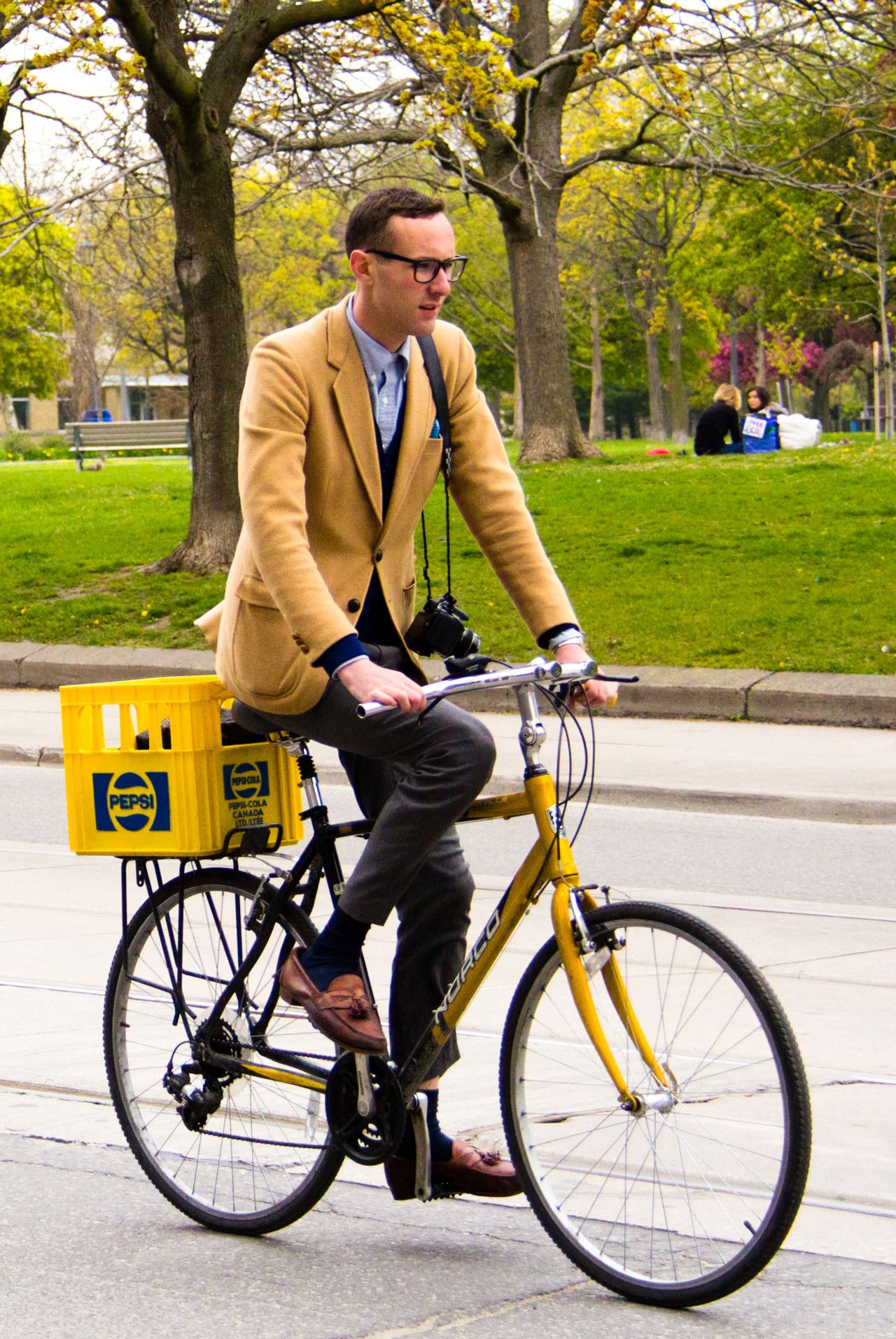
If you envisioned something like the "accountant" on the right then you aren't thinking Nerdy enough.
No, what you should be thinking of is what type of Nerd is riding the bicycle and which of the following things they enjoy.
Star Wars
Star Trek
Game of Thrones
The Hobbit
Dune
Warhammer
Dungeons & Dragons
Superheroes
Science Fiction
Engineering
Design
Math
Etc
And thus you end up with bicycles featuring Darth Vader or other characters from Star Wars.
Or even a bicycle decorated to look like a Speeder from Star Wars.
Or decorated to look like a starship from the newer Star Trek TV shows (Discovery, etc)
Or simply painted and the numbers added from the Enterprise. Fashion choices optional.
The point, essentially, is that true Nerds are going to decorate or modify their bicycles due to their Nerdish interests.
They're not going to decorate it so they look like the accountant way at the top.
They might also choose to invest time and energy (and money) into making their bicycle more engineered than normal. Eg. A solar powered bicycle?
Or maybe they completed a bicycle mechanic training course and they want to make something very artistic and sculptural? The type of person who designs their own custom bicycles.
The point I am trying to make is that there are many different kinds of Nerds, and this fact is reflected in the type of bicycles they would ride.
For example...
What would a Math Nerd want to ride?
Well, I present to you... The Pi Bike.
Seriously, there's no limit to what is out there and available for Nerds to create. As Nerds we are inherently creative people, whether we are copying what we see in movies, TV or comic books, or whether we are exploring topics such as engineering, design, math and more.
It is really just a matter of having the proper skills. And one place to get those skills would be to take a course at the Quadra Bike School with Smokey Dymny. Learn the skills, build your dream bicycle(s), maybe even make a YouTube channel dedicated to making nerd bicycles.
And then SELL those Nerd Bicycles for a tidy profit.
Who says Bicycle Mechanics cannot make money???
How Rare is a Paladin? (By the Numbers, 2nd Edition AD&D)
If 2nd Edition AD&D is the reference, paladins are pretty rare. The stat requirements alone indicate that paladins are certainly not average:
Strength 12, Constitution 9, Wisdom 13, Charisma 17.
Getting a 9 Con isn't hard, and while 12 Str and 13 Wis is certainly above average, they're not difficult to get. It is the 17 Charisma that everyone knows is a challenge.
When rolling 3d6 getting a 17 Charisma requires rolling two sixes plus either a 5 or a 6 on the third dice. Getting a 17 or 18 are equally difficult when rolling 3d6 because there's only 2 ways to do it. Either 665 or 666. That's it. As anyone who has studied Finite Math knows, the order doesn't matter. 566 is still as equally hard to roll as 665. We are just organizing them in numerological order to keep it simple.
In contrast rolling a 16 is much easier. There are two ways to do it: 664 or 655.
And 15? Three ways to do that: 663, 654, 555.
Any character class with a stat requirement of 15 or higher is therefore pretty rare, as there is only so many ways to roll the stats needed to be a Druid or a Paladin, with paladins obviously being far more rare. Druids only need a 15 Charisma and there are 7 ways to roll that on 3d6. Paladins need a 17 or higher, so druids logically would be 3.5 times more common than paladins. At least that, because don't forget the paladin also needs to fulfill the Str, Con and Wis requirements.
And compared to commoners walking around with average stats of 10.5? Well, let's just say that being a peasant has no stat requirements other than being alive.
14: 662, 653, 644, 554
13: 661, 652, 643, 553, 544
12: 651, 642, 633, 552, 543, 444
11: 641, 632, 551, 542, 533, 443
10: 631, 622, 541, 532, 442, 433
9: 621, 531, 522, 441, 432, 333
And so on.
Basically there are twenty-four different ways to roll numbers between 9 and 12 on 3d6, but there are only sixteen ways to roll a stat of 13 or higher. And consequently, only sixteen ways to roll a 8 or lower. So only 56 possible rolls. Out of which only a 17 or 18 Charisma can be a paladin, so there's only 2 out of 56 ways to get the necessary Charisma requirement on 3d6.
So 3.57% of people would have the necessary Charisma.
Only 22 of 56 rolls would garner at 12 Str or higher, so 39.2% of people would be strong enough.
40 out of 56 would have 9 Con or higher, so 71.4%.
And 16 out of 56 would have 13 Wis or higher, so 28.6%.
The chances of getting ALL four of these stat requirements???
Roughly 0.286%. I ran the math twice to double check.
So out of 400 people rolled using the 3d6 dice method, only 1 person would have the necessary stats to potentially become a paladin.
So what about Alignment?
Not everyone is fit to be a paladin, even if they do have the necessary stats.
Being Lawful Good should be fairly rare, depending upon the fantasy world. Eg. Practically non-existent in a world like Dark Sun, but more common in a region like Solamnia in the Dragonlance world of Krynn. Or very common in a world like Eternia (He-Man and the Masters of the Universe, etc).
But if we fudge the averages a bit for argument's sake, the "average fantasy world" should have lots of people who are Neutral in alignment, with almost equal numbers of good and evil people.
Say: 30% good, 40% neutral, 30% evil.
It is fairly safe to say that in an "average" fantasy world there should be more neutral people than there is good people, and likewise evil people. But not necessarily more than both.
Likewise not everyone is lawful or chaotic. Many people are neutral in that respect. Thus it would be safe to say that lawful, neutral and chaotic people might be divided like so:
30% lawful, 40% neutral, 30% chaotic.
So even amongst a society of only Good people, only 30% of them would be Lawful Good.
And that compared to the average fantasy world only about 9% of people would be LG.
Taken together?
So only 1 in 400 people would have the necessary stats to be a paladin, but only 1 in 11 people would have the alignment requirement.
So only 1 in 4400 people could potentially become a paladin because they have the stats and alignment requirements.
But this assumes that person would even choose to BECOME a paladin. They might instead be a farmer, or a merchant, or a blacksmith. Any number of things.
If forced by circumstances, it makes sense that people might HAVE to become warriors, and potentially paladins if they had the right combination of stats and alignment. But it should still be really rare.
In a kingdom of perhaps 1 million people only 227 people would have the necessary alignment and stats. But what if most of them ended up becoming priests, warriors, farmers, merchants, etc?
Suffice to say, paladins, these paragons of virtue, should be almost as rare as unicorns.
And in certain worlds, like Dark Sun, paladins don't even exist. There are no paladins in Dark Sun, instead they have far more gladiators.
Some other worlds, like say one based on King Arthur and the Knights of the Round Table, well, paladins might be far more common.
And then there's the matter of the rolling system. Some DMs allow 4d6 drop the lowest, which skews the results and statistics.
And of course, what edition of Dungeons and Dragons a group is playing. It is far easier to become a paladin in 3rd or 5th edition. But for realism's sake there should only be so many.
And I didn't even touch on the topic of the death rate of paladins...
The BBC Version of Gormenghast
What you get instead is a giant fantastical castle, the size of a large city, and one of the best villains you will ever see in any books: Steerpike.
Steerpike is arguably the perfect villain. He has motivations. He is ambitious. He is in love. He is Machiavellian in his schemes.
The BBC version of Gormenghast only covers the first two books of the series, ignoring the third book "Titus Alone", in which the character Titus Groan journeys beyond the valley of Gormenghast, gets lost and people don't even believe him when he describes the castle of Gormenghast.
The good news is that you can watch the BBC version of Gormenghast on YouTube. See the videos further below.
Alternatively you can easily get copies of the books (or ebooks or audiobooks) from your local libraries because Gormenghast is considered to be a classic.
The Adventures of the Bogatyr, Short Fiction Series
The Bogatyr is a class of Slavic knight popular in folktales and legends from the Slavic region of Eastern Europe (Ukraine, Russia, Belarus, Romania, etc). In the stories Bogatyr knights often were wanderers who sometimes possessed supernatural powers or magic which helped them to achieve their goals. Eg. In one story one of the characters gained "giant strength" from a giant Bogatyr and was super strong afterwards.
In my literary fantasy world of Korovia however, I have taken it a step further. My version of Bogatyrs has access to specific kinds of magic, similar to a wizard or a cleric (as per Dungeons and Dragons), or similar to a Witcher from Andrzej Sapkowski's books, and in order to test the knight's abilities I even made a 2nd Edition Bogatyr character class which clearly spells out what the Bogatyr's abilities are.
But I wasn't done obviously. I have also written a series of 8 pieces of short fiction which are available to read via Amazon Kindle (a new one is released every 2 months), and I am planning to release them as an anthology in paperback and hardcover formats sometime in 2023.
THE ADVENTURES OF THE BOGATYR
- The Bogatyr & the Cursed Inn
- Dark Shadow in the Moonlight
- The Bogatyr & the Rusalka's Lament
- The Bogatyr & the Gentle Giant
- A Bag of Silver, A Bag of Bones
- The She-Wolf of Eraska
- The Midnight Dragon
- The Bogatyr & the Cursed Parcel (Coming January 1st 2023)
The individual stories are priced at $0.99 each, with the exception of two of the stories which are significantly longer and priced at $2.99 each.
I am also working on a trilogy of three Bogatyr novels, which will follow the adventures of Ilya and Dobrynya and other Bogatyr knights. But for those who love a good story about a wandering knight / monster hunter, with the occasional bit of time travel / time paradoxes in there, plus some dark fantasy, grimdark, or old school Sword & Sorcery well then this is something you are likely to enjoy reading... Please enjoy the short stories!
Readers interested in my other fantasy stories should check out the following:
The Adventures of Wrathgar (heroic fantasy novel series)
Wulfric the Wanderer (Sword & Sorcery short fiction series)
Maps of Gormenghast
The problem with Gormenghast (the trilogy of books by Mervyn Peake) is that there isn't really any official maps of the castle and region.
For those that don't know, Gormenghast is a huge castle depicted in the series of books by Mervyn Peake which were incredibly influential on other writers during the latter half of the 20th century.
So influential that it got a BBC mini series in the early 2000s. (The image on the above right is a depiction of the huge castle that was shown in the BBC version.)
The castle is effectly the size of a city. Not a small city either. Much bigger than that. Simply massive.
Due to the lack of official maps various people have made their own versions of what they think the castle might look like on a map, sometimes with their depictions suggesting something similar to the Forbidden City in China.
But they all, in my opinion, fall short of depicting the massive size of Gormenghast. The thing that people seem to forget is that Gormenghast should have a population of 10s of thousands of people, but only about 10% of the castle is actually occupied. Many of the rooms and buildings within Gormenghast have been abandoned for generations. So if there was say 40,000 people living there, the castle itself should be big enough to house 400,000 people.
For a context a small city of 40,000 people still takes up a good chunk of space. Thus Gormenghast should be roughly 10 times the size of a small city.
The maps below thus aren't really an accurate depiction to the true scale of Gormenghast. It should be tens of miles across, not just a few miles.
The above one basically copies the look of the Forbidden City in China.
Looking for fantasy books by indie authors? Browse indie fantasy books at ArcaneTomes.Org
Popular Posts
-
Maps of fantasy worlds can be quite interesting if you're into that sort of thing. Here is two of my favourites: Westeros , the world ...
-
If you visit the following link it will take you to an interactive Google map which will provide you with a list of locations where events t...
-
Map of Earthos, the world of Game of Thrones / A Song of Ice and Fire
-
Can't get enough Game of Thrones / A Song of Ice and Fire? Well here is some more maps and even family trees from the great families o...
-
"The Relationship Agreement" is a reference to the TV show "The Big Bang Theory". If you haven't seen it the show fo...
-
Below - Maps of the galaxy in the Star Trek universe + interior maps of the Enterprise and Voyager ships.
-
Finding books, modules, etc from old 1st Edition / 2nd Edition AD&D games can be quite tricky sometimes so many of us gamers resort to d...
-
The world of David Eddings' books series the Belgariad and Mallorean was set in the following world. I read the books back during the 1...
-
Sean Connery has good looks. Sean Connery has an attractive accent. But he isn't particularly good at acting. He never took any actu...
-
Map of Hogwarts, from the fictional world of Harry Potter Another version of Hogwarts, from the fictional world of Harry Potter ...